Butterfly transect results
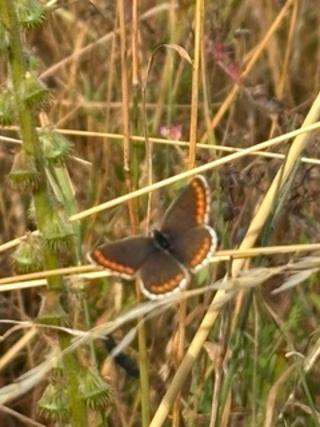
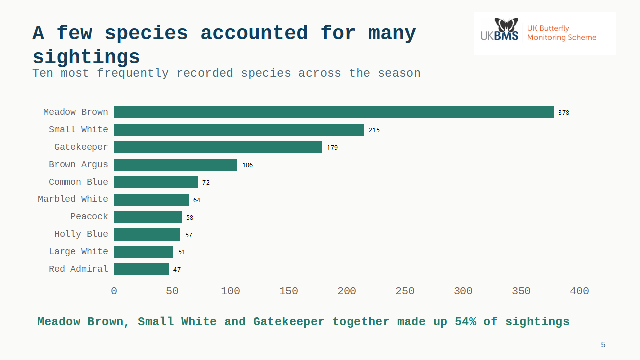
Butterfly Count - the results are in and it’s good news for the Trust.Our dedicated recorder has analysed the data; here are a few highlights:First, just a quick reminder of what was done -The area surveyed (the transect) was divided into five sections which are shown on the map, The blue area(1) is the CWCT newly planted woodland and the wildflower areas.Section two (purple) is a drove alongside the south side of the CWCT land just where we had a hedge renovated (laid) in 2022.The hedge has not subsequently been so drastically cut as most field hedges, usually once every two years and late in the winter. Section 3 is a short area of woodland (green), Section 4 is arable land bounded by a low cut hedge (purple) and Section 5 is the parkland in front of Heale House.(green again).There are a number of caveats to comparing these areas -, they are not all the same length, so the time to see butterflies will vary. When there are a good number of butterflies the recorders will slow down as they identify them and so spend even longer in some areas whereas a small number will mean the recorders will speed up and spend little time in that particular area.However taking into account these imperfections it is remarkable that out of the 1452 sightings 726 were in the Trust land. Good news for our efforts to conserve and increase biodiversity. The area alongside the Trust land had 237 sightings,Section 3 had 54 sightings but it is quite short so that was understandable. The long arable section gave 232 sightings and section 5 in front of Heale House had180.So the Trust section was roughly as long as each of sections 4 and 5 but had 3-4 times as many butterflies as each of these sections.What about diversity of sightings?The second figure shows the most abundant species.Meadow browns were number one, their caterpillars feed on grass and so did well in areas of uncut grass.Other species of butterflies were seen but in small numbers, in total 27 species were recorded. There are lots of other details given by the data, some species, like Brimstones, peaked in the early part of the season but most species peaked in June/July. The heat this year probably meant more species declined earlier than they would have done in a cooler year.So the main conclusion is that even a short period of rewilding(5 years) an arable area gives an increase in biodiversity, measured here as butterflies but probably extends to moths and other insects. Certainly the long grass will increase numbers of reptiles(particularly slow worms) and small mammals.These will attract owls and other raptors, for instance while we were planting Yeoman's Copse we were accompanied by a hovering kestrel looking for voles.An increase in native plants is a slower process as they were destroyed as they appeared during decades of arable farming and so there is not a good seed bank in the soil.However, squirrels and jays are trying their best to replant with acorns and ash seedlings but more herbaceous flowering plants will probably not arrive unless we plant them as the area is surrounded by sterile arable fields.Again many thanks to the volunteers who braved the heat and analyzed the data. I am sure the further annual development of the data base of biodiversity in this area of particular importance to biodiversity(SCC nature recovery plan 2025) will guide our long term management of the land.Well done Team.(if you’d like to get involved with counting next year please contact CWCT- you’d be very welcome!